
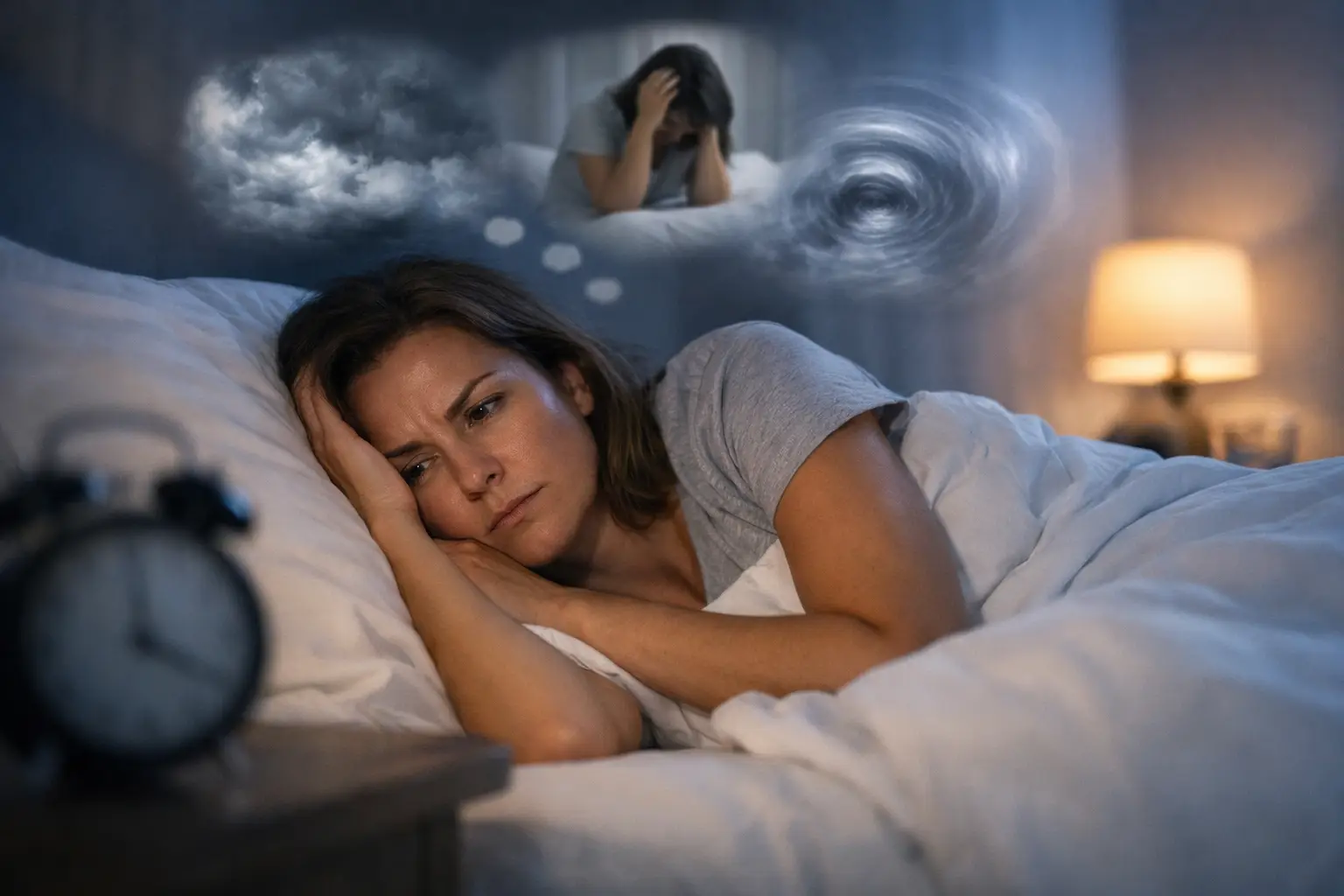
Your body is finally still, the room is quiet, and somehow your mind decides this is the perfect time to replay every awkward moment, unfinished task, and worst-case scenario. Nighttime anxiety can feel especially cruel because it shows up when you are tired, vulnerable, and just trying to rest.
If you are trying to figure out how to stop anxiety at night, the first thing to know is this: you are not failing at sleep, and you are not weak. Anxiety often gets louder at night because distractions are gone. There is less noise, less movement, and less to compete with your thoughts. For many people, bedtime becomes the first moment they have to feel everything they pushed through all day.
The good news is that anxiety attacks are not random. They follow a pattern, which means they can be interrupted. You may not be able to force sleep on command, but you can reduce the momentum of the spiral and help your nervous system shift out of threat mode.
Why anxiety seems to hit harder at night
During the day, your brain is busy managing tasks, conversations, errands, and stimulation. At night, all of that drops away. If your system has been running under stress, it may finally catch up to you when you lie down.
There is also a physical side to this. Fatigue lowers your ability to think flexibly. A small concern that would feel manageable at 2 p.m. can feel catastrophic at 2 a.m. When you are exhausted, your brain is more likely to overestimate danger and underestimate your ability to cope.
For some people, nighttime anxiety is tied to a specific trigger like health anxiety, relationship stress, grief, trauma, or fear of not sleeping. For others, the spiral starts with one thought and quickly expands. What if I do not sleep? What if I cannot function tomorrow? What if something is wrong with me? Once fear about anxiety itself enters the picture, the cycle gets stronger.
How to stop anxiety
at night by calming the body first
When your mind is racing, it is tempting to argue with every thought. Sometimes that helps. But if your body is already activated, logic alone may not land. Start with your nervous system.
Try loosening the pressure to sleep immediately. That sounds backward, but it matters. The more you demand sleep, the more alert you become. Instead, tell yourself, I am going to help my body feel safe and let sleep come later.
Then focus on one physical cue at a time. Slow your exhale. Relax your jaw. Drop your shoulders. Unclench your hands. Press your legs gently into the bed and notice the support under you. These are small signals, but they tell your brain that there is no immediate emergency.
A simple breathing pattern can help if you keep it gentle. Inhale for four, exhale for six, and repeat for a few minutes. The longer exhale tends to reduce activation. If counting makes you more anxious, skip the numbers and just breathe out a little longer than you breathe in.
Temperature can help too. A cool washcloth on your face, a sip of cold water, or shifting to a more comfortable blanket can interrupt the spiral just enough to create space. Grounding works best when it is concrete, not complicated.
What to do when your thoughts will not slow down
Once your body comes down a notch, you can work with the thoughts more effectively. The goal is not to make every anxious thought disappear. The goal is to stop treating each one like a five-alarm fire.
Start by naming what is happening. You might say, This is an anxiety spiral. My brain is scanning for danger because I am tired and stressed. Naming the pattern creates a little distance between you and the thought.
Then resist the urge to solve your whole life in bed. Night is a terrible time for major decisions. If your brain keeps insisting that you must figure something out right now, write down a few words on paper and permit yourself to revisit it tomorrow. A note like email landlord, call doctor, or think about budget tomorrow is often enough to help your mind let go.
If anxiety is fueled by catastrophic thinking, try responding with something more balanced. Not blindly positive, just honest. Instead of I will never sleep, try I have had hard nights before and still made it through. Instead of Something is seriously wrong with me, try Anxiety feels intense, but intensity is not proof of danger.
This is where self-talk matters. You do not need a perfect script. You need a believable one.
Get out of bed if the spiral keeps building
If you have been lying there for a while and feel more frustrated by the minute, getting out of bed may actually help. This is not giving up. It is preventing your brain from linking your bed with panic, dread, or pressure.
Keep the lights low and do something quiet and boring for 10 to 20 minutes. Sit in a chair with a blanket. Read a few pages of something neutral. Sip water or caffeine-free tea. Avoid doom-scrolling, checking the news, or doing anything emotionally activating. The goal is to lower stimulation until your body feels sleepier again.
This step can be especially useful if your anxiety spiral is blending with insomnia. Staying in bed while increasingly distressed often teaches your brain that bedtime is a battleground. Breaking that association takes patience, but it helps over time.
Nighttime habits that make spirals less likely
If nighttime anxiety is frequent, what you do before bed matters almost as much as what you do during the spiral. Think of it as reducing the load on your nervous system before the quiet hits.
A short buffer between your day and your bed can make a real difference. That might mean dimming lights, putting your phone down earlier, stretching for five minutes, showering, or journaling out the mental clutter before you lie down. You are not trying to create a perfect routine. You are giving your mind a clear signal that the day is ending.
It also helps to avoid using bedtime as your only emotional processing time. If your brain has no space during the day to feel stress, sadness, anger, or uncertainty, those feelings often show up at night. Even ten minutes earlier in the evening to check in with yourself can reduce the pressure later.
Physical habits matter too, but this is where nuance is important. Exercise can improve sleep and reduce baseline anxiety for many people, especially when done consistently. But if you work out intensely too close to bedtime, it may keep some people alert. Caffeine, alcohol, and heavy late meals can also make nighttime anxiety worse, though the effect varies from person to person. Pay attention to your own pattern instead of assuming there is one rule for everyone.
When anxiety thoughts are linked to deeper stress
Sometimes the nighttime thoughts are not really about nighttime. It is about accumulated stress, unresolved fear, or a nervous system that rarely gets to stand down.
If you are dealing with trauma, burnout, relationship instability, health fears, or constant overwhelm, bedtime may simply be when the backlog surfaces. In that case, coping skills at night are helpful, but they may not be enough on their own. You may also need support during the day.
That could look like therapy, a support group, structured self-help tools, or a conversation with a medical provider if sleep disruption and anxiety are persistent. Self-help can be powerful, and so can professional care. They do not compete with each other. They work best together when anxiety has become hard to manage alone.
At Fitness Hacks for Life, we believe mental health support should be accessible, practical, and compassionate. Sometimes the bravest move is learning one calming skill. Sometimes it is reaching for more support.
When to seek extra help
If nighttime anxiety is happening often, affecting your ability to function, causing panic attacks, or leading you to fear bedtime itself, it is worth getting additional help. The same is true if your anxiety is tied to trauma symptoms, depression, or thoughts of harming yourself. You do not need to wait until things become unbearable.
Support is not a last resort. It is a form of care.
The next time anxiety starts building in the dark, try not to measure your success by whether you fall asleep immediately. Measure it by whether you interrupted the spiral with even one act of steadiness. One slower breath, one grounded thought, one choice to stop fighting yourself – that is how trust is rebuilt, night by night.
– High-functioning anxiety looks like capability from the outside, but feels like constant exhaustion from the inside
– It is driven by fear, not motivation — and it is not sustainable long-term
– Common signs include over-preparing, people pleasing, catastrophizing, and inability to rest
– Functioning well does not mean you do not deserve support
– Treatment works — anxiety responds well to both therapy and self-directed tools
—
What Actually Helps
Name it. Calling it what it is — anxiety, not just “being a worrier” or “being type A” — matters. It shifts you from self-criticism to self-understanding.
Practice tolerating uncertainty.** High functioning anxiety is largely a response to uncertainty. The goal is not to eliminate uncertainty — it is to build your tolerance for it. Start small. Decide without researching it to death. See that the outcome is okay.
Reduce reassurance-seeking. Every time you seek reassurance, you reinforce the anxiety loop. Practice sitting with the discomfort of not knowing for short periods. It gets easier.
Build real rest into your schedule.Not passive distraction — actual rest. Time with no agenda, no productivity, no screens. Your nervous system needs this to regulate.
Work with a therapist.** Cognitive Behavioral Therapy (CBT) is one of the most effective treatments for anxiety. It helps you identify and challenge the thought patterns that drive the anxiety cycle.
— Start With Our Anxiety Workbook
If you want to begin working through your anxiety with structured, evidence-based tools, our **Anxiety Workbook** uses CBT techniques to help you understand your triggers, challenge anxious thoughts, and build a personal management plan.
[Download the Anxiety Workbook → fitnesshacksforlife.org/our-wellness-shop](https://fitnesshacksforlife.org/our-wellness-shop/)**
Work With a Therapist
For many people with high-functioning anxiety, working with a therapist is the most transformative step they take. Our sister site TheraConnect connects you with licensed therapists and coaches who specialize in anxiety — so you can get real support, not just manage.
[Find a therapist at TheraConnect → theraconnect.net](https://theraconnect.net)**
—Frequently Asked Questions
Is high-functioning anxiety the same as generalized anxiety disorder (GAD)?**
They overlap significantly but are not identical. GAD is a clinical diagnosis with specific criteria. High functioning anxiety is a descriptive term for people whose anxiety does not significantly impair their daily functioning — even though it causes significant internal distress. Someone with high-functioning anxiety may or may not meet the criteria for GAD.
**Can high-functioning anxiety get worse over time?**
Yes. Without intervention, the constant output required to manage it becomes harder to sustain. Burnout is common. Many people with high-functioning anxiety hit a wall in their thirties or forties when the coping mechanisms that worked in their twenties stop being enough.
**Is medication right for high-functioning anxiety?**
That is a conversation to have with a doctor or psychiatrist. Medication can be very helpful for anxiety — either as a standalone treatment or alongside therapy. It is not a sign of weakness. It is a medical option worth discussing.
**Can you have high-functioning anxiety and depression at the same time?**
Yes — anxiety and depression commonly co-occur. If you are experiencing both persistent anxiety and low mood, worthlessness, or loss of interest in things you used to enjoy, please speak with a mental health professional.
**How do I explain high functioning anxiety to someone who thinks I am fine?**
Try this: “Anxiety is not always visible. I function well on the outside, but inside I am running at a level of stress and worry that is exhausting and unsustainable. Just because I appear fine does not mean I feel fine.”
—
*The information in this post is for educational purposes only and does not replace professional mental health care. If you are in crisis, call or text 988.*
Leave a Reply