

Before you even start searching for a therapist, the most important work begins with you. Taking the time to figure out your goals, budget, and what you’re looking for in a person is the foundation for everything that follows. This prep work acts as your compass, guiding you toward a professional who can actually meet your needs and making the whole process feel less overwhelming.
Defining What You Need from Therapy
Jumping into a therapist search without knowing what you need is like starting a road trip with no destination. You might get somewhere, but it’s probably not where you intended to go. The most crucial part of finding a therapist happens before you even open a search engine—it’s about looking inward.
This initial step shifts you from a vague sense of “I need help” to a concrete idea of what that help looks like. It’s the difference between “I feel bad all the time” and “I want to learn practical skills to manage my social anxiety at work.” Getting specific empowers you to find not just any therapist, but the right one.
Identify Your Primary Goals
First, take a moment to really think about what’s pushing you to seek therapy now. Are you dealing with a specific crisis, or are you looking for more general support? Your answer here will immediately help you narrow down your search to therapists with the right specialties.
To get the ball rolling, consider these questions:
- What specific feelings are you struggling with? Think about things like constant worry, a persistent sense of sadness, or feeling completely overwhelmed by stress.
- Is there a specific situation you need help navigating? This could be anything from a major career change, grieving a loss, or trying to improve a key relationship.
- What would you like to change about your life? Maybe you want to build healthier habits, get better at setting boundaries, or learn to communicate more effectively.
Your answers don’t need to be perfect; they’re just a starting point. A good therapist will help you explore these areas in much greater depth, but having a preliminary idea is key. It’s also helpful to have a basic understanding of the various psychotherapy types, as certain approaches are better suited for specific goals.
“Your connection with your therapist is the number one factor affecting your success in therapy. Decades of research have shown that finding the right therapist for your needs improves the likelihood of therapeutic success.”
This flowchart breaks down the process of defining your therapy needs into three clear areas: your goals, the practical logistics, and your personal preferences.
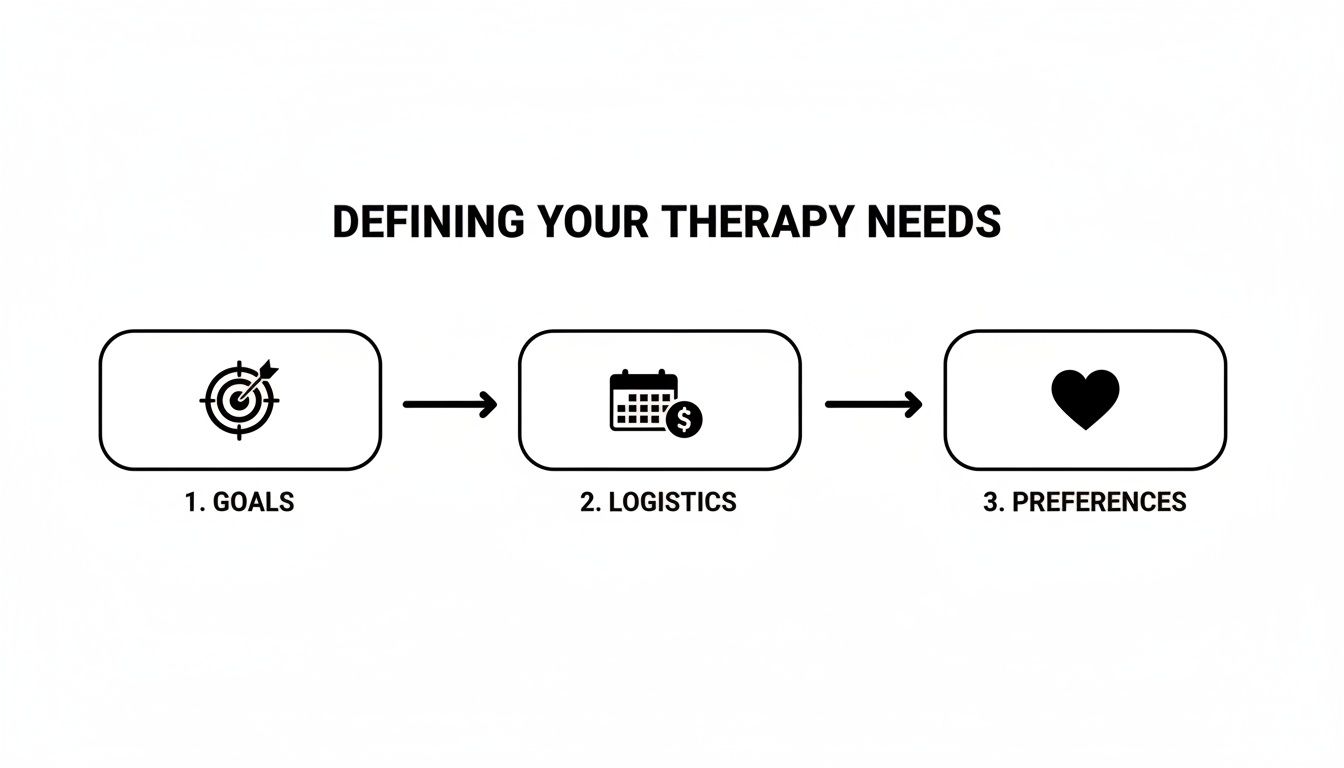
Following these steps gives you a personalized roadmap, making your search for a therapist far more intentional and a lot less chaotic.
Sort Out the Practical Details
Beyond your emotional goals, the practical stuff plays a huge role in whether therapy will be sustainable for you. Figuring out the logistics now will save you a ton of frustration down the road.
Insurance and Budget
Start with your insurance. Call the number on the back of your card or log into their online portal to get the specifics on your mental health benefits. You’ll want to know your copay, your deductible, and if you need a referral from your primary care doctor.
If you’re planning to pay out-of-pocket, figure out what you can realistically afford each month. Don’t be afraid to ask about this—many therapists offer sliding-scale fees, which means they adjust their rate based on your income.
Scheduling and Format
Next, think about your schedule. Do you need evening or weekend appointments? Are you looking for a weekly session, or would bi-weekly work better?
You also need to decide between in-person and online therapy. Online sessions offer incredible flexibility, but some people find that meeting in a dedicated space away from home is more effective. There’s no right answer—just what works for you. The crucial role our mental care professionals play in your well-being often depends on finding a setup that fits seamlessly into your life.
Consider Your Personal Preferences
Finally, think about the kind of person you’d feel comfortable opening up to. Therapy is an incredibly personal relationship, and feeling a real sense of rapport is non-negotiable.
Ask yourself a few questions:
- Gender: Do you have a preference for your therapist’s gender?
- Age: Would you feel more comfortable with someone closer to your age, or someone with a bit more life experience under their belt?
- Communication Style: Are you looking for someone who mostly listens and guides, or do you prefer a therapist who is more direct and action-oriented?
- Cultural Background: Is it important that your therapist shares your cultural, racial, or spiritual background, or has a deep understanding of it?
Answering these questions helps you build a profile of your ideal therapist. It transforms what can feel like a massive, overwhelming search into a much more targeted and manageable process.
Discovering Where to Find Qualified Therapists

Alright, you’ve done the internal work and have a much clearer picture of what you need. Now it’s time to start the actual search.
The good news? You have more options at your fingertips than ever before. Gone are the days when your only choice was a single referral from your family doctor. Knowing where to look can turn what feels like an overwhelming task into an empowering process of finding a handful of great potential candidates.
This is where you shift from reflection to action. With your goals and practical needs in hand, you can tap into a mix of modern digital tools and old-school community resources to find professionals who genuinely align with what you’re looking for.
Harnessing the Power of Online Directories
Online therapist directories are easily one of the most powerful tools in your search today. Think of them as specialized search engines built specifically to connect you with a therapist, loaded with filters that let you slice through thousands of profiles to find a manageable few. In fact, over 80% of clients now start their therapy search online, making these platforms a critical first stop.
These directories allow you to filter by the things that matter most to you, like:
- Location: Find clinicians near you for in-person sessions or those licensed in your state for virtual care.
- Insurance: This is often the first box people check to make sure therapy is affordable from the get-go.
- Specialty: Zero in on professionals who focus on anxiety, trauma, couples counseling, or your specific area of need.
- Therapeutic Approach: If you’re set on a specific method like Cognitive Behavioral Therapy (CBT), you can find a specialist.
For example, if you’re looking for support with specific conditions like ADHD or Autism, certain resources are designed to help with finding a qualified CBT therapist who has that exact expertise. This level of detail is precisely what makes online directories so effective.
When you’re scrolling through a directory, don’t just stop at the headshot and credentials. Take a minute to read their personal statement. This is where a therapist’s personality, philosophy, and approach really come to life, giving you a much better feel for who they are as a person.
Beyond the big platforms, our sister site, Thera Connect, was created by Fitness Hacks For Life to help bridge the gap between clients and clinicians. It’s a community-first ecosystem built on trust, designed to connect you directly with licensed professionals who share our mission.
Exploring Your Existing Network and Community
While digital tools are fantastic, don’t forget about the resources already hiding in plain sight within your own network and community. Sometimes, the most solid referrals come from trusted, real-world connections.
A great place to start is your primary care physician. They usually have a network of mental health professionals they trust and can recommend someone who’s a good clinical fit based on your health history.
Another powerful—and often overlooked—resource is your Employee Assistance Program (EAP). Many companies offer EAPs as a free, confidential benefit that includes a certain number of therapy sessions. This can be an incredible way to get short-term support or a professional referral at absolutely no cost to you.
Finally, consider these community-based options:
- University Counseling Centers: If there’s a local university with a psychology or counseling program, they might offer low-cost therapy to the public. These sessions are typically provided by graduate students who are supervised by licensed professionals.
- Specialized Non-Profits: Organizations that focus on specific issues (like grief, addiction, or LGBTQ+ support) often provide their own counseling services or can refer you to providers they know and trust.
By combining these different avenues, you create a much stronger search strategy. Looking at online directories, checking your EAP, and exploring local resources casts a wider net. This approach dramatically increases your chances of finding not just any therapist, but a therapist who feels like the right partner for your journey.
Building this diverse list of potential candidates is the next concrete step toward getting the support you deserve. You can learn more about navigating these options in our guide to accessible mental health care.
You’ve got a list of potential therapists. Great. Now for the most critical part of the whole process: figuring out which one is the right person for you.
This isn’t about finding the single “best” therapist in the world. It’s about finding the person whose expertise, personality, and approach click with your specific needs. Think of it less like an exam and more like a series of low-key interviews. You’re not just hoping they’ll take you on as a client; you are actively choosing them, too.
You’re looking for a professional who makes you feel safe and understood enough to get into the real work.
Understanding Different Therapeutic Approaches
Walking into the world of therapy can feel like learning a new language. You’ll see a ton of acronyms and terms flying around—CBT, psychodynamic, somatic—and it can be overwhelming. You don’t need a Ph.D. in psychology, but having a basic handle on a few common methods can help you decipher a therapist’s profile and imagine what working with them might be like.
These different methods, or modalities, are just the frameworks therapists use to help you explore and heal.
To give you a head start, here’s a quick-reference table breaking down some of the most common therapeutic modalities you’ll encounter. It’s a simple guide to what each approach focuses on and the kinds of issues they are often used to address.
Comparing Common Therapeutic Approaches
| Therapeutic Modality | Core Principle | Best For |
|---|---|---|
| Cognitive Behavioral Therapy (CBT) | Focuses on identifying and changing destructive thought patterns and behaviors in the present moment. | Anxiety, depression, phobias, OCD, practical problem-solving. |
| Psychodynamic Therapy | Explores how past experiences, especially from childhood, unconsciously shape your current feelings and actions. | Deeper self-exploration, understanding recurring patterns in relationships, and unresolved past trauma. |
| Somatic Therapy | Centers on the mind-body connection, using physical sensations and movement to release trauma stored in the body. | Trauma, PTSD, chronic stress, anxiety, and issues that manifest physically. |
| Dialectical Behavior Therapy (DBT) | An offshoot of CBT that teaches skills for managing intense emotions, tolerating distress, and improving relationships. | Borderline Personality Disorder (BPD), self-harm, emotional dysregulation, and suicidal ideation. |
Remember, this is just a starting point. Many therapists are “eclectic,” meaning they blend different approaches to fit the client.
The connection you build with your therapist is often far more important than the specific modality they use. Study after study confirms that the therapeutic alliance—that bond of trust and collaboration between you and your clinician—is the single greatest predictor of a good outcome.
So, while understanding their approach is helpful, the real question is whether their style and personality feel like a match for yours.
What to Look For in a Therapist’s Profile
A therapist’s online profile is their professional front door. It’s their chance to give you a glimpse of who they are and how they practice. When you’re scrolling through directories or their personal websites, look beyond the basics like location and insurance.
Pay close attention to the language they use. Does their bio sound warm and inviting, or is it overly clinical and academic? Their choice of words can tell you a lot about their personality.
Also, notice their credentials—those letters after their name (like Ph.D., LCSW, or LMFT) signify their specific training and license. If you’re curious about what all those letters mean, our guide can help you decode them: What Do the Letters After a Psychologist’s Name Actually Mean?.
The Importance of Cultural Competence
Finding a therapist who “gets you” is about more than just sharing hobbies. It means finding someone who understands and respects the unique fabric of your identity.
Cultural competence is a therapist’s ability to work effectively with people from backgrounds different from their own. This includes your race, ethnicity, sexual orientation, gender identity, religion, disability, and socioeconomic status.
A culturally competent therapist will:
- Avoid making assumptions about your life based on your identity.
- Remain open and curious to learn about your cultural background.
- Acknowledge how systemic issues like racism and homophobia can impact mental health.
- Create a space where you can talk about all parts of who you are without fearing judgment.
You have every right to want a therapist who shares your background if that’s what feels most affirming and safe for you. Sadly, traditional referral paths don’t always meet these diverse needs. In 2021 alone, over 57 million American adults were living with a mental illness, yet a huge number of them never get professional help. Finding a clinician who truly understands your cultural context can be a powerful factor in closing that gap.
Making First Contact and What to Ask

You’ve done the research and have a shortlist of potential therapists. Now comes the part that trips a lot of people up: actually reaching out. It’s completely normal to feel a wave of anxiety at this stage, but I promise it doesn’t have to be complicated or scary.
Think of this initial contact as a brief, low-pressure introduction. You’re not committing to anything. You’re just gathering a bit more information and getting a feel for their personality to see if you two might click.
Crafting Your First Email
For many of us, sending an email feels much more manageable than picking up the phone. It gives you the space to organize your thoughts and say exactly what you mean without the pressure of a live conversation.
The goal here is to be concise. You absolutely do not need to pour out your life story in this first message. Just give them enough context to know what you’re looking for and whether they’re the right person to help.
Here’s a simple, effective script you can adapt. I’ve seen it work time and time again.
Subject: Inquiry About New Client Openings
Hello Dr. [Therapist’s Last Name],
My name is [Your Name], and I found your information on [Psychology Today, your website, etc.]. I’m looking for a therapist to help me navigate [mention 1-2 key issues, like “anxiety and relationship challenges” or “grief and career stress”].
Your profile mentioned a specialization in [mention their approach, e.g., EMDR or Acceptance and Commitment Therapy], and I’m interested in learning more about how you work with clients.
I have [Your Insurance Provider, e.g., Aetna] or I’ll be paying out-of-pocket. Could you let me know if you are currently accepting new clients? I’d also appreciate the chance for a brief consultation call if you offer one.
Thank you,
[Your Name]
[Your Phone Number]
This email is perfect because it’s direct, gives them all the key details, and proposes a clear next step. It shows you’ve done your homework while respecting their time.
Getting Ready for the Consultation Call
Most therapists offer a free 15-20 minute consultation call. This is your shot to ask questions, check out their communication style, and just see if you feel a comfortable rapport. Don’t waste it.
Going into this call with a few questions ready will make a world of difference. The goal isn’t to grill them, but to start a real conversation that helps you decide if their style fits what you need.
Here are the key things you want to get straight:
- Logistics: Confirm their session fees, if they take your insurance (and are in-network), and what their schedule looks like.
- Experience: Ask specifically about their work with people dealing with similar issues to yours.
- Approach: Try to get a sense of what a therapy session with them would actually feel like.
Remember, this is a two-way street. You are interviewing them just as much as they are assessing if they can help you.
Insightful Questions to Ask Your Potential Therapist
It’s so easy to get on the phone and completely blank on what you wanted to ask. I always recommend jotting down a few questions beforehand. Move beyond the basics to get at the heart of their therapeutic style.
Questions About Their Experience and Approach:
- Based on the little I’ve shared, how might you approach working with me?
- Can you tell me more about your experience with [your specific concern, e.g., complex trauma, OCD]?
- How do you structure your sessions? Are they goal-oriented and structured, or more open and client-led?
Questions About the Therapeutic Relationship:
4. If I were to ask your former clients to describe you, what would they say?
5. How important is the therapist-client relationship in your view of the healing process?
6. How do you and your clients track progress?
Pay attention to how they answer as much as what they say. Do they sound warm and engaged? Do you feel like they’re actually listening?
Trust your gut. Finding the right therapist is deeply personal. If the conversation flows and you feel a sense of ease, that’s a fantastic sign you might have found your person.
Navigating the Costs of Therapy
Let’s just get this out of the way: therapy can be expensive. For many people, the potential cost is a huge barrier that stops them from even starting the search for help. But it absolutely does not have to be the end of the story.
There are more pathways to affordable, high-quality care than you might think. It’s not about finding the cheapest option; it’s about finding sustainable, professional support that actually fits your budget. You just have to know where to look and what questions to ask.
And if you’re worried about cost, you’re far from alone. Over 1 billion people worldwide are living with a mental health condition, but the gap between needing help and getting it is staggering. Globally, fewer than 7% of people with a mental health or substance use disorder receive what’s considered effective treatment. That means for every ten people who could use support, eight or nine are trying to manage on their own. You can find more details on these statistics directly from the World Health Organization.
Look for Sliding-Scale Fees
One of the best ways to make therapy fit your budget is to find a therapist who offers a sliding scale. This is just a flexible payment model where your session fee is based on your income. It’s designed specifically to make therapy accessible, no matter what you earn.
You might be surprised how many private practice therapists set aside a few spots in their schedule for sliding-scale clients. They don’t always advertise it on the front page of their website, so you often just have to ask.
It doesn’t have to be an awkward conversation. When you reach out for an initial consultation, you can simply ask:
- “I’m really interested in your work, but I have a limited budget. Do you offer any sliding-scale or reduced-fee spots?”
- “Could you tell me if you have a sliding scale and what that range looks like?”
Most therapists who offer this are incredibly understanding. The process is usually straightforward and is meant to find a fee that feels manageable for you and fair to them.
Tap Into Community and University Resources
Some of the most affordable—and still very high-quality—options are hiding in plain sight, right in your local community.
Community Mental Health Clinics
These clinics are often funded by local government or non-profits with the sole mission of serving the community. They almost always operate on a sliding scale that can go quite low, making them a fantastic resource for consistent, long-term care. The only catch is that they can sometimes have a waitlist, but it’s always worth checking.
University Training Programs
Got a university nearby with a graduate program in psychology, counseling, or social work? Check if they have a training clinic. You can get therapy from graduate students who are in the final stages of their training and are working toward licensure.
Don’t let the word “student” throw you. Every single session is closely supervised by a licensed, seasoned clinical professor. You’re essentially getting two clinical minds focused on your well-being, often for a tiny fraction of the cost of a private practitioner.
Get Smart About Your Insurance
If you have health insurance, digging into your benefits can unlock huge savings. It’s about knowing the difference between in-network and out-of-network providers.
In-Network vs. Out-of-Network
- In-Network: These therapists have a direct contract with your insurance company. You’ll usually pay a simple, fixed copay for each session once you’ve met your deductible.
- Out-of-Network (OON): These therapists don’t have a contract with your insurance. This means you pay their full fee upfront, but your insurance company will then reimburse you for a percentage of that cost—often 50-80%.
A lot of people hear “out-of-network” and immediately write it off as too expensive or complicated, but that can be a mistake. Going OON can dramatically expand your options, giving you access to a much wider pool of therapists with different specialties.
If you find a therapist you really connect with but they don’t take your insurance, ask them if they provide a “superbill.” This is just a detailed receipt you send to your insurance company to get your reimbursement. It’s a seriously underutilized tool for making the therapist you really want to see much more affordable.
Common Questions About Finding a Therapist
Starting the search for a therapist brings up a ton of questions. That’s completely normal. You might feel a mix of hope and a whole lot of uncertainty, and that’s okay. Let’s walk through some of the most common questions to give you a bit more clarity and confidence.
Remember, you’re not just looking for any professional with a degree. You’re looking for an ally, someone who can guide you through some deeply personal stuff. Nailing down the practical details first makes the whole process feel less overwhelming.
How Do I Know It’s the Right Time for Therapy?
This is probably the biggest question people have: “Do I really need this?” The honest answer is there’s no perfect time, but your own life will give you pretty clear signals when therapy could make a real difference.
You don’t have to be at rock bottom to get help. In fact, getting support before you hit a crisis point can be incredibly powerful. It might be time to reach out if you’re noticing:
- Feelings that won’t quit: A lingering sadness, anxiety, or irritability that’s starting to get in the way of your day-to-day life.
- Friction in your relationships: Maybe you’re fighting more with your partner, pulling away from friends, or just can’t seem to connect with the people you care about.
- Stress that feels crushing: When work, family, or just life in general feels like it’s too much to carry on your own.
- A general sense of being ‘stuck’: You want to grow, understand your own patterns, or build healthier habits, but you just don’t know how to start.
Ultimately, you have to trust your gut. If a little voice inside is even whispering that you could use some support, that’s more than enough reason to start looking.
What’s the Difference Between All the Credentials?
Once you start looking at therapist profiles, you’ll see a jumble of letters after their names—LCSW, LMFT, Ph.D., LPC. It can feel like alphabet soup. While they all mean the person is a licensed professional, their training and focus can be a little different.
Here’s a quick and dirty guide to what some of them mean:
| Credential | Title(s) | Typical Focus |
|---|---|---|
| Ph.D./Psy.D. | Psychologist | Often have deep training in psychological testing, research, and a wide range of therapy approaches. |
| LCSW/MSW | Licensed Clinical Social Worker | Trained to see the whole picture, focusing on how your environment and social factors impact your mental health. |
| LPC/LMHC | Licensed Professional Counselor | Specifically trained in counseling techniques to help with a broad spectrum of emotional and behavioral challenges. |
| LMFT | Licensed Marriage and Family Therapist | Experts in relationship dynamics, whether it’s with couples, families, or other relational systems. |
Here’s the most important thing to remember: the letters aren’t nearly as important as the therapist’s actual experience with your specific issues and how you feel when you talk to them. Decades of research have shown that the therapeutic alliance—the bond between you and your therapist—is the single biggest predictor of success in therapy.
What Is the First Session Actually Like?
The thought of that first appointment can be really nerve-wracking. People often imagine lying on a couch being analyzed, but it’s usually much more relaxed and conversational than that.
Think of it as a get-to-know-you meeting. Your therapist wants to hear your story, understand what brought you in, and figure out if they have the right skills to help you. They’ll likely ask about your background, what you’re struggling with right now, and what your goals are.
But it’s a two-way street. This is your chance to interview them, too. Do you feel like they’re really listening? Do you like their communication style? Does it feel like a space where you could eventually open up?
When Is It Okay to Change Therapists?
It is always okay to change therapists. Full stop.
This isn’t like breaking up with a friend; it’s about advocating for your own health. Therapy is a huge investment of your time, money, and emotional energy, and you deserve to work with someone who is a good fit.
Sometimes a therapist is a great person, just not the right person for you. Other times, you might see some genuine red flags that tell you it’s time to move on, like:
- You consistently feel judged, unheard, or dismissed.
- The therapist talks about themselves way too much.
- They have poor boundaries (e.g., trying to be your friend, being late all the time).
- Months go by and you feel like you aren’t making any progress at all.
You aren’t locked in with the first therapist you meet. Learning to trust your instincts and find the right support is a huge, empowering part of the process itself.
At Fitness Hacks For Life, we believe that finding the right support is a crucial step toward well-being. Our mission is to provide accessible resources and clear pathways to care, so no one has to navigate their mental health journey alone. Explore our guides and community at https://fitnesshacksforlife.org.
Frequently Asked Questions:
There’s no perfect moment, but clear signs include persistent feelings (sadness, anxiety, irritability) interfering with daily life, relationship friction, overwhelming stress, or feeling “stuck” despite wanting growth. You don’t need to hit rock bottom—trust your gut if a voice inside suggests you could use support. Starting early can be very powerful.
Common ones include:
1. Ph.D./Psy.D. (Psychologist): Deep training in testing, research, and various therapy approaches.
2. LCSW (Licensed Clinical Social Worker): Focus on environment, social factors, and a holistic view.
3. LPC/LMHC (Licensed Professional Counselor): Broad counseling for emotional/behavioral issues.
3. LMFT (Licensed Marriage and Family Therapist): Specializes in relationships and family dynamics.
The letters matter less than their experience with your issues and the connection (therapeutic alliance) you feel—that’s the biggest predictor of success.
It’s usually relaxed and conversational (not like the stereotypical couch analysis). It’s a mutual get-to-know-you: they’ll ask about your background, current struggles, and goals, while you assess if they listen well, match your style, and create a safe space. Treat it as an interview both ways.
Always—it’s 100% okay and often necessary. You’re investing time, money, and energy, so you deserve a good fit. Switch if you feel judged/unheard, they overshare or have poor boundaries, or you see no progress after months. Trusting your instincts here is empowering.
Credentials get them licensed, but the real key is their experience with your specific concerns + the bond you build. Research consistently shows the therapeutic relationship is the top factor in successful outcomes—prioritize feeling heard and comfortable over just the letters after their name.
Leave a Reply